Enfield’s Planning Committee is responsible for determining planning applications that shape Enfield’s neighbourhoods, influence housing delivery, and set precedents for future development. However, the past year has been marked by declining output and controversies that raise serious questions about governance, value for money, and public confidence.
Deteriorating value for money
The Planning Committee plays a decisive role in deciding whether planning applications for major developments, and those attracting a high level of public interest, go ahead. How the Committee performs therefore matters, both for housing delivery and public confidence.
The Chair of the Planning Committee receives a Special Responsibility Allowance of over £8,000 per year, regardless of how often it meets, or the number of decisions made.[1]
In recent years, there has been a sharp decline in the number of Planning Committee meetings and the volume of decisions (see Appendix A for more details). This effectively means the current Chair, Cllr Mahym Bedekova, received over £800 per meeting.
In our view, this represents poor value for money, particularly given the significantly reduced workload and the fact that meetings typically last around two hours, and raises legitimate questions about the use of taxpayers’ money.
A year of controversy
2025 began with a change in the Planning Committee’s leadership. Cllr Mahym Bedekova was appointed Chair at the end of 2024, following the departure of the previous Chair, Cllr Sinan Boztas.
According to the Enfield Dispatch, Cllr Boztas was removed shortly after the paper revealed that Labour members of the Committee had voted to approve an application for an unsafe dropped-kerb submitted by then Labour councillor Mustafa Cetinkaya.[2] The decision to approve the application was taken against the advice of planning officers, who had raised multiple safety concerns and recommended the application be refused.[3]
Warnings were ignored.
Concerns about how the decision would be perceived were raised at the time. The minutes of the meeting show that before the application was approved, an opposition councillor warned the Planning Committee members that approving the application against the officer’s recommendation would “look as though members were doing a favour for a fellow councillor” describing this as “totally unacceptable”.[4]
Council officers also reminded the Committee members that a near-identical proposal for a dropped-kerb at the same property had previously been refused by both the Council and the Planning Inspectorate on appeal.[5]
Despite these warnings, Cllr Sinan Boztas (then Chair of the Committee) proposed members approve the application. This proposal was seconded by Cllr Kate Anolue and councillors Mahym Bedekova (then Vice Chair), Nelly Gyosheva and Ahmet Hasan, along with independent member Thomas Fawns (currently suspended by the Labour Party), also voted in favour of granting planning approval.[6] This voting record matters because Cllrs Bedekova, Anolue, Hasan and Fawns remain members of the Planning Committee.
The decision created a perception that there was one rule for councillors and another for residents – a damaging impression for any local authority committee.
A reversal without explanation.
The application was later returned to the Committee after the Council’s legal team concluded that the original decision had not been properly considered.[7] In June 2025, officers re-presented the same information to the Committee and reiterated their safety concerns.
This time, the Committee unanimously refused the application. Cllrs Bedekova and Anolue, who had previously voted to approve it, now voted to refuse. No explanation was given for their change in position in the published minutes. Councillors Hasan and Fawns were not present.[8]
While it was right to overturn a flawed decision, the absence of an explanation raises serious questions about consistency, transparency and accountability, particularly given Cllr Bedekova’s appointment as Chair.
These concerns were later reinforced when the Planning Inspectorate dismissed Cllr Cetinkaya’s appeal on highway safety grounds and with explicit reference to the earlier refused appeal.[9] The Inspectorate’s decision confirms the Committee’s original approval was fundamentally unsound.
In our view, none of the councillors who voted to approve the application should remain members of the Committee unless they can demonstrate that lessons have been learned from this episode. The original decision showed very poor judgement, including an apparent willingness to place the interests of a fellow councillor ahead of public safety, and a failure to apply the Borough’s planning policies in a fair, impartial and consistent manner.
New concerns emerge about the leadership of the committee.
Six months later, in December 2025, further concerns emerged when the Enfield Dispatch reported that Cllr Bedekova had been operating a House in Multiple Occupation (HMO) for several years without the required planning permission, including during her time on the Planning Committee.[10]
The full article, including Cllr Bedekova’s response is available here.
In our view, this would be a troubling revelation for any member of the Planning Committee. It is particularly serious when the individual concerned has served on the Committee for several years and participated in decisions on HMO applications while lacking permission, or having sought permission, for her own HMO property.[11]
As Chair of the Planning Committee, the responsibilities are especially significant: overseeing debate, enforcing standards of conduct, controlling public participation, exercising a casting vote where decisions are tied, and playing a formal role with senior officers in determining which applications are referred to Committee.[12] Given these powers, the Chair’s conduct must meet the highest standards. Where that standard has not been met, and where public confidence has been repeatedly undermined by a pattern of decisions and conduct, the only credible course is for the Chair to step down to protect the integrity of the Committee.
A Committee in Need of Reform
Planning meetings offer one of the most tangible ways for residents to experience local democracy up close. Research shows experiences and perceptions of planning committees can play an important role in shaping public trust in local democracy and in residents’ willingness to engage with it.[13]
Research also indicates that public trust in councillors has fallen to a historic low, raising wider concerns about the health of democratic governance.[14] Against this backdrop, the behaviour of the Planning Committee described in this report is troubling and, in our view, contributes to growing public scepticism about the integrity and accountability of local decision-making.
Public confidence in Enfield’s Planning Committee depends on knowing that councillors, and particularly the Chair, fully comprehend the planning rules, apply them consistently, and are seen to act with integrity and objectivity. It also depends on the Committee demonstrating that councillors and residents are subject to the same rules, without exception.
Enfield residents deserve a Planning Committee that:
- Upholds the highest ethical standards
- Applies the rules consistently
- Explains its decisions transparently
- Provides value for money
Until those expectations are met, it is right to ask difficult questions. Restoring confidence will require a new Chair, clearer accountability, higher standards of conduct, and a renewed focus on effective decision-making.
Appendix A: Planning Committee Analysis
While Planning Committee decisions are only one part of the housing delivery pipeline, our analysis shows a sharp decline over the past year both in the number of Planning Committee meetings held and the number of homes approved. Together these figures point to a significant slowdown in decision-making, with clear implications for housing delivery in Enfield.
Between 2020 and 2022, the Committee met an average of 20 times per year, determined 55 applications, and approved 2,604 new homes annually. This comfortably exceeded Enfield’s housing requirement at the time and reflected a strong pipeline of homes coming forward. [15]
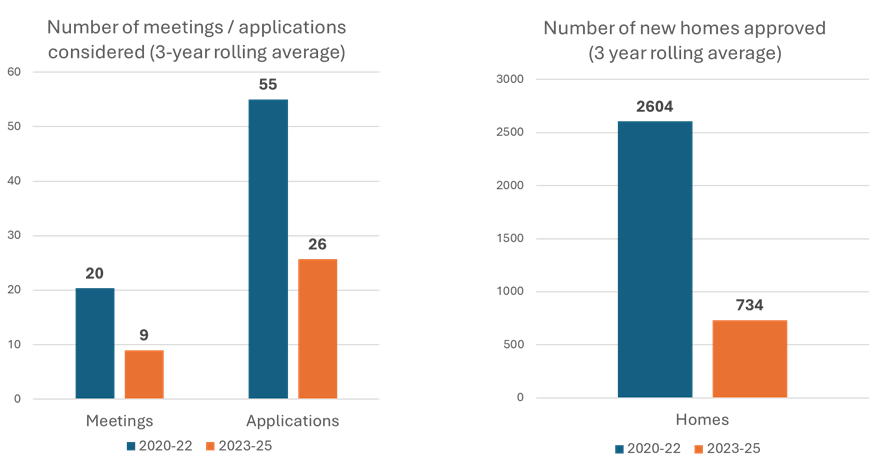
Since then, performance has deteriorated markedly. Between 2023 and 2025, the Committee met an average of nine times in a year, determined 26 applications, and approved only 734 homes annually. In 2025, just 460 new homes were approved, a level of output far below what is needed to meet housing targets or deliver the homes Enfield needs.
Based on these figures, the number of new homes approved at Planning Committee has fallen by over 70%. Nationally, the number of homes granted planning permission has also fallen, but only by around 20–25%, Enfield’s decline is far sharper.[16] While national market conditions clearly play a role, they do not explain a reduction of the magnitude seen in Enfield. The data points to additional local factors suppressing the flow of major housing schemes coming forward for decision which require further investigation.
The scale of the decline raises serious questions about local governance and whether the Planning Committee is currently operating in a way that supports the delivery of much-needed homes.
Appendix B: References and Notes
[1] Special Responsibility Allowances can be viewed here.
[2] Labour councillor’s dropped kerb to be reconsidered by planning committee – Enfield Dispatch
[4] See Planning Committee Meeting Minutes here.
[5] Ibid.
[7] Labour councillor’s controversial dropped kerb rejected – Enfield Dispatch
[8] See Planning Committee Meeting Minutes here.
[9] See Planning Inspectorate decision here.
[10] Planning committee chair operating HMO without permission – Enfield Dispatch
[11] For example, see minutes for application 23/01144/FUL here.
[12] For more information about the role of the Planning Committee and Chairs see: London Borough of Enfield Constitution, Part 2 – The Constitution, Planning Committee, Committee details table, row “Chair” (“Chair appointed by Council”), pdf p.56 and Part 5 Codes of Conduct, Chapter 5.2 ‘Planning Committee Code of Practice’.
[13] Lawson et al (2022), Public participation in planning in the UK. A review of the literature.
[14] Ipsos Veracity Index 2025 | Ipsos
[15] Information sources: Enfield Council Planning Committee agendas, officer reports and minutes. All applications are counted, including deferrals and refusals. Analysis of housing numbers avoids double counting by counting the number of homes each scheme proposes only once i.e. at the time when it was first approved. Housing numbers are NET additional homes i.e. after accounting for losses associated with the application due to demolition.
[16] See Live tables on planning application statistics – GOV.UK.
 Better Homes Enfield