
Last night, Enfield Council’s planning committee approved plans to demolish 795 homes across the Joyce Avenue and Snells Park estates and replace them with up to 2,028 new homes.
The demolition and construction will be conducted over 23-years, eventually delivering an additional 1,233 homes in buildings of up to 26-storeys. The development will be a considerable upheaval for current residents but despite this, 78.5% of those eligible to vote were in favour of the scheme.
A positive about the scheme is that the number of social rent homes (council housing) across both estates will increase from 434 to 625, and there will be a substantial increase in the number of social rent family-sized homes with 3 or more bedrooms, which will help to ease existing overcrowding in the area.
The remaining homes will either be shared ownership/shared-equity (388) or full-priced private/market rate homes (1,015). However, a large majority of these are unlikely to be affordable to most local first-time buyers, given average incomes in the area.

A few new houses are proposed, but most of the homes will be in apartments.
Whilst 33% of the social rent homes will be family-sized, only 12% of the full priced private/market rate homes will be family homes which is considerably less than the 44% needed according to the Council’s Local Housing Needs Assessment.
The council’s planning officers justify this because downsizing will free up larger family-sized dwellings elsewhere in the borough. There is some evidence for this – for example, the latest Census showed that more than 68,000 properties in Enfield are under-occupied, one of the highest rates of under-occupancy in London, so there may be potential for downsizing.
At least 10% of the new homes would be ‘wheelchair user dwellings’, and all others would meet the standards for ‘accessible and adaptable dwellings’ i.e. they could be adapted for wheelchair use if needed.
The new estate would be ‘car-lite,’ so the number of car parking spaces would be reduced from 537 to 402. Existing residents would be eligible for car parking spaces, but no parking will be available for future residents, except Blue Badge holders. The area has good access to amenities and public transport, and access to the nearby Silver Street station will be improved as part of the scheme by installing a new and much needed pedestrian crossing.
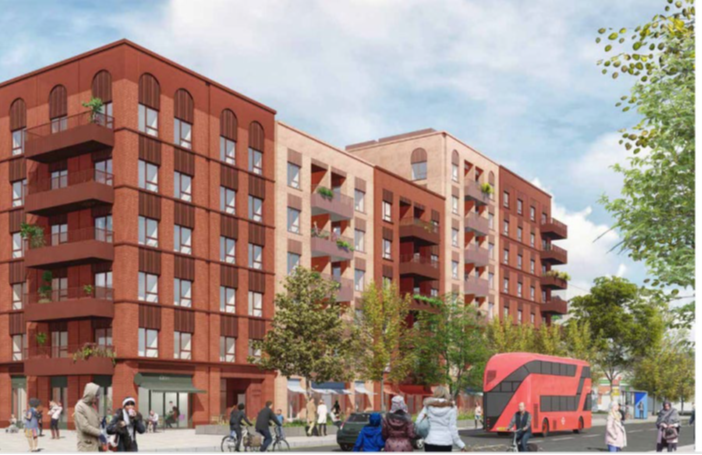
The scheme will deliver changes to Fore Street shopping area, including new spaces for shops, and cafes and additional greenery / trees.
Whist there are positives about this scheme we have a number of concerns.
Parks and green spaces
The amount of green open space per head across the estates, including landscaped areas and play-facilities, will be reduced. This is a concern as the local area already has one of the highest deficits of green space in Enfield and planning policies suggest the quantum of public green space per head should be increased in these areas as a result of development, not reduced.
However, officers suggest green space delivered as part of the new scheme will be designed more coherently and say this will improve the quality and usability of the green space and parks. We sincerely hope they are right; the proposed scheme is almost entirely apartments, so new parks and green spaces will be extremely important for residents, families, children, and community cohesion. Our concern is that we have far too often seen significant differences between promises made about parks and play spaces during the planning approval stage and what is actually delivered some years later.
There appears to be no information about maintenance of the new public open spaces, or who would pay for their upkeep i.e. whether this is the council or future residents. This is important as the new public open spaces are likely to be intensively used and will require regular maintenance and renewal, so it is important to know who will pay and be responsible.

Image of one of the proposed new play spaces
Daylight
Around 40% of rooms in the new scheme (for which details were available) would not meet the required daylight standards, increasing to 60% of rooms in some blocks. We are concerned at just how dark some of these homes could be, and this further underlines the importance of good quality and sufficiently sized outdoor space.
Furthermore, the scheme would have a negative impact in terms of sunlight and daylight on a number of homes and buildings surrounding the site, as well as negative impacts of overshadowing, loss of outlook and loss of privacy. The council planning officers decided that the benefits of the scheme outweigh the harm to these homes. In our view, the council should consider offering compensation to local residents who are impacted and consider the potential purchase of the affected properties, which could then be refitted to address some of the issues and converted to social rent housing stock, as part of the scheme.
Wind
Areas around some of the proposed new buildings would create unsuitable and uncomfortable strong wind conditions for pedestrians and cyclists due to their design. It is important that this issue is addressed during the early design stage, especially given the scheme’s focus on active travel.
Carbon emissions
Hot water and heating for the new homes will be provided by the council’s own District Heat Network and the council suggests that this will reduce the carbon dioxide emissions by 75% compared to using gas boilers. This reduction in emissions is huge and means the scheme can avoid paying hundreds of thousands of pounds in carbon offsetting fees, which it would otherwise be liable for. It would also enable the council to generate future income by acting as the sole energy provider to residents.
However, the claims about emission reduction are misleading. The District Heat Network will rely on heat from the new Edmonton Incinerator, which is forecast to emit 700,000 tonnes of carbon dioxide per year when fully operational, including from burning of fossil fuels (plastic). The scheme’s calculation of carbon dioxide emissions associated with providing the heat to the new buildings simply ignores these emissions. It could be argued that the council’s dependency on the District Heat Network acts as a financial incentive to burn more waste, rather than investing in ways to reduce waste and increase rates of recycling, or to use other less harmful methods of dealing with waste.
Summary
On the whole we think the scheme could bring significant benefits to the Fore Street area and it’s encouraging that there will be an increase in social rent housing, especially family sized social rent homes, as well as renewal of existing social housing stock. However, in our view, there are a number of important aspects that require further attention, careful management, or a different approach entirely, in order to ensure that potentially harmful impacts of the scheme are minimised.

Image of proposed new apartments and green space
 Better Homes Enfield