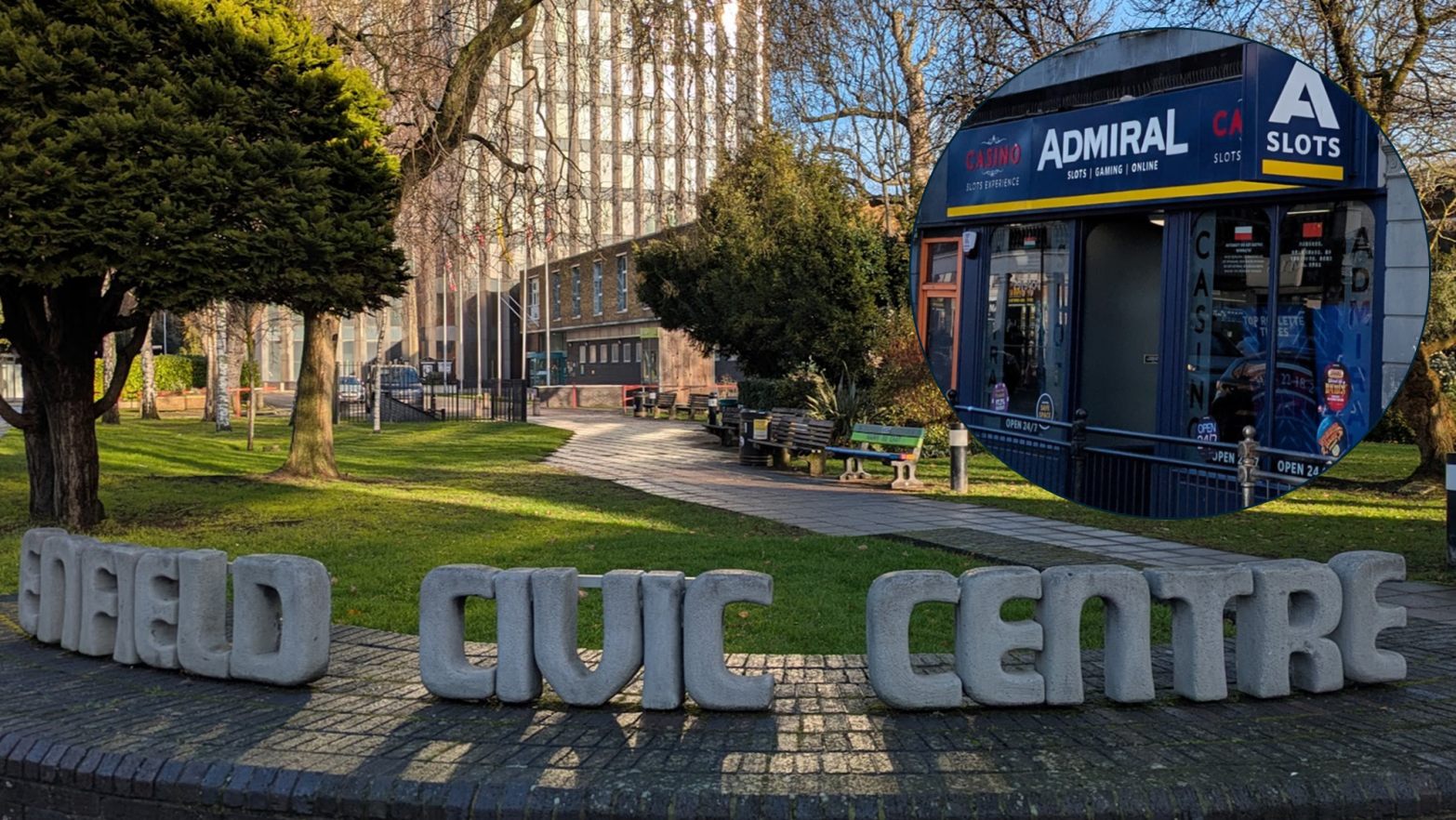
Enfield Council has spent over £7 million preparing its new Local Plan intended to shape Enfield for the next 15 years. Yet despite this significant investment, the Plan fails to adequately address the growing number of adult gaming centres and betting shops on Enfield’s high streets.
In a recent Enfield Dispatch article, local community group REACT (Residents of Edmonton Angel Community Together), highlighted the increasing concentration of gambling premises in some of the borough’s most deprived neighbourhoods. They warned that adult gaming centres and gambling shops are being disproportionately targeted at communities facing the greatest social and economic disadvantage, raising serious concerns about the targeting of marginalised communities.
These concerns are widely shared. Cllr Susan Erbil, the Cabinet Member for Planning and Regulatory Services, stated that the Council is “doing everything in our power” to prevent further gambling premises opening on Enfield’s high streets.
However, the Council’s new Local Plan does not support this claim.
Rather than strengthening the Council’s ability to manage the spread of gambling premises, the new Local Plan weakens it. The Plan removes existing clear and enforceable planning protections that have helped limit the proliferation of betting shops and it fails to introduce robust new policies to effectively control the spread of adult gaming centres. In practice, this leaves the Council with weaker planning powers than it currently has.
Other London boroughs have demonstrated that stronger action is possible. Brent Council’s Local Plan, adopted in 2022, included explicit policies to control adult gaming centres through clear thresholds and spacing requirements designed to protect town centres and vulnerable areas. Enfield Council has chosen not to adopt a similarly robust approach.
Residents should be concerned that so much public money has been spent developing a new Local Plan, yet it misses a critical opportunity to robustly tackle the spread of betting shops and adult gaming centres.
This is not a new issue. The concerns recently reported in Enfield Dispatch reflect a consistent pattern of local media coverage and sustained community opposition to the spread of adult gaming centres for over 5-years. Taken together, this points to a long-standing and well-documented problem, particularly affecting some of the borough’s most deprived neighbourhoods.
The Local Plan process was precisely the moment for the Council to respond to this concern. Instead, the new Plan suggests that little has been learned from past experiences, or from the voices of residents and community groups, who have repeatedly raised the alarm about the clustering of gambling premises.
The inevitable conclusion is that controlling the spread of gambling premises has slipped down the list of priorities. Residents are therefore entitled to question whether their concerns have been meaningfully acted upon, and whether the millions of pounds of public money spent developing the Local Plan represents value for money. Planning policy is ultimately judged by its outcomes, not by assurances – and in this case, actions speak louder than words.
The bottom line is that Enfield’s councillors talk about concern, harm and vulnerability, and those concerns are valid. But the Local Plan is where those concerns could have been turned into clear, enforceable planning policies but they simply haven’t been. After years of work and millions of pounds of public money, residents deserve far better. They deserve genuine action through tightly worded and enforceable policies, not simply expressions of concern and excuses. The council’s statements over the years seem to repeatedly suggest it is powerless to control adult gaming – but that is now because of its own failure to act when it had the chance.
Explainer: Why Enfield’s Planning Policy Falls Short
Policy TC6 in Enfield’s new Local Plan is likely to be weak in practice as it talks generally about clustering of town-centre uses and mentions betting shops and amusement centres but sets no clear enforceable limits. There are no clearly defined spacing rules, no maximum percentages of different types of gambling premises or non-retail uses, and so no automatic refusal to control the concentration of gambling establishments. As a result, the planning policy is too vague and open to broad interpretation – this means refusals will be harder to enforce and far more vulnerable to being overturned on appeal. Furthermore, it does not seek to control changes of use between different types of gambling establishments, which means there are no planning controls to prevent betting shops becoming adult gaming centres.
By contrast, Brent’s Local Plan sets maximum percentages of frontage, requires gaps between gambling premises, and uses clear thresholds. This approach is more robust and has already been subject to Planning Inspectorate scrutiny, which provided Enfield Council ample opportunity to learn from their approach and to define a policy that could be robustly enforced. This opportunity was missed.
 Better Homes Enfield