Introduction and Summary
The Government’s New Towns Taskforce (NTT) published its report in September 2025. It recommended that land at Crews Hill & Chase Park (CH&CP) be considered as a potential site for a new town, capable of delivering 21,000 new homes. The Government’s response listed CH&CP as one of the three most promising locations for a new town.
Since the NTT report and the Government’s response were published, speculation has grown about the types of homes that might be built at CH&CP.
This is difficult to answer.
As it stands, nobody knows for sure what types of homes will be built. The local community has not been properly involved yet, and the Government still hasn’t published a decision on whether CH&CP will actually be selected as a site for a new town.
If it is, which seems likely, it will fall to the appointed delivery body to decide what gets built in practice. And even if it happens, building a new town takes decades, so what’s being talked about now could look very different in 10, 20 or 40 years.
What we can do is look at what the key players are already saying. That gives us a decent steer on the direction of travel, to get a sense of what lies ahead for CH&CP.
Our review of what’s currently available suggests:
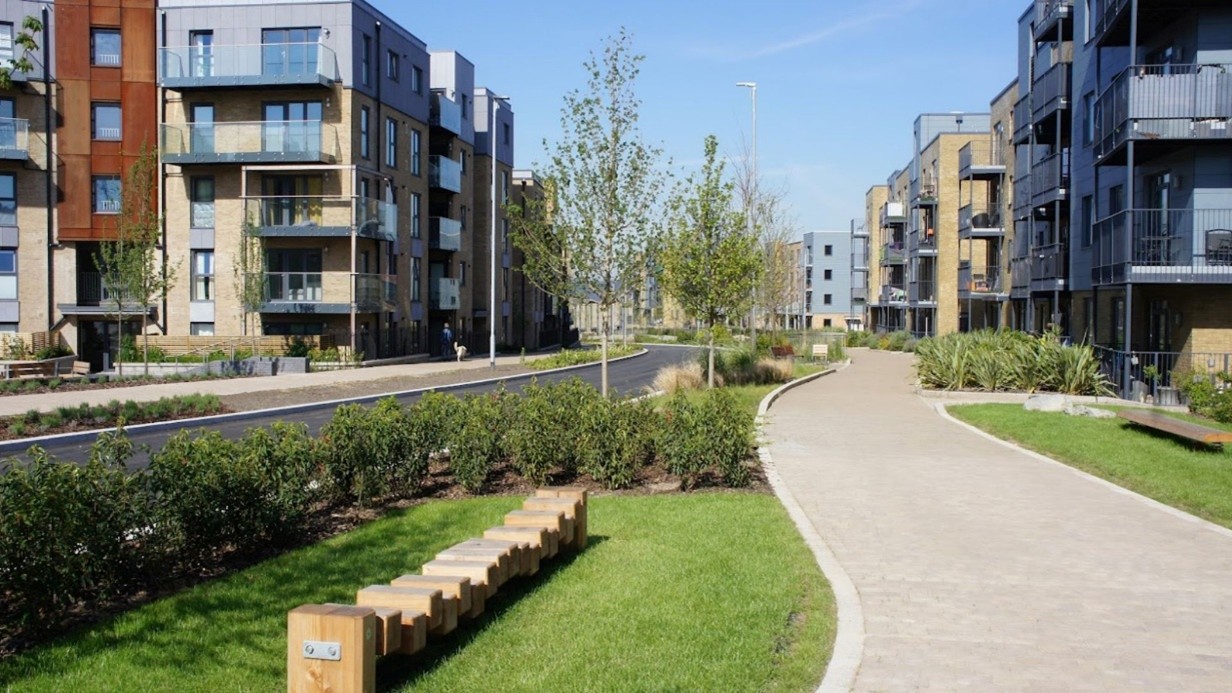
- There’ll be a mix of housing. A lot of it is likely to be in mid-rise blocks of around 5–6 storeys, especially in areas closest to stations and shops. This is like a European-style approach, characterised as “gentle density” by some urban designers. Think mansion blocks and mid-rise streets, not towers, but also not car-dependent sprawl, which brings traffic, congestion, and air quality problems into surrounding neighbourhoods.
- We’ve seen no evidence of tower blocks being proposed. Although some mid-rise buildings might just about meet the definition of ‘high-rise,’ which is 7 or more storeys, or above 18 metres tall.
- There will be plenty of family-sized homes with 3-4 bedrooms. But London-wide housing needs suggest there will be more 1–2-bedroom properties overall.
- What looks very unlikely is the idea that most homes would be low-rise 3–4-bedroom houses with driveways and gardens, as has been suggested by the Leader of Enfield Council. That simply doesn’t square with what the key players are saying about the need for ‘car-lite’ and ‘optimal’ density development.
- Using the Council’s viability work and comparable local new-build prices, we can estimate that – in present-day prices – a 1-bedroom flat would cost around £360,000, a 2-bedroom flat would be £450,000 and a 3-bedroom terrace house would be £650,000. Assuming a 10% deposit and 4.5× income multiple for a mortgage, a £650k 3-bed home would need a £65k deposit and an annual household income of around £130k.
- If the Government’s stated aim for affordable housing is met, it would mean that around 1 in 5 of the new homes will be available for social rent i.e. traditional council-home-style tenancies. This would mean around 4,200 could be social rent homes out of the 21,000, which is lower than the 6,000 council homes referred to by the Leader of Enfield Council.
- The NTT report claims new towns delivered by development corporations have ‘build-out’ rates averaging 600+ homes per year, although the long-term average can be far lower. Even at 600 homes a year, a 21,000-home new town implies roughly 35 years of build-out, and nearer 40 years once set-up and early planning are included.
The remainder of the report, which can be downloaded here and below, is split into eight parts, examining what each of the key players has said and providing examples of relevant comments.
1. What has the New Towns Taskforce said?
2. What has the Deputy Mayor and the Greater London Authority said?
3. What has Transport for London said?
4. How many of the homes will have 3 or more bedrooms?
5. How much will the homes cost?
6. How many social rent affordable homes will there be?
7. When will the homes be built?
8. So, what does this mean?
A note on the images used: Most of the images used in the report are of developments in Enfield, which have been included as examples of mid-rise style density development.
 Better Homes Enfield