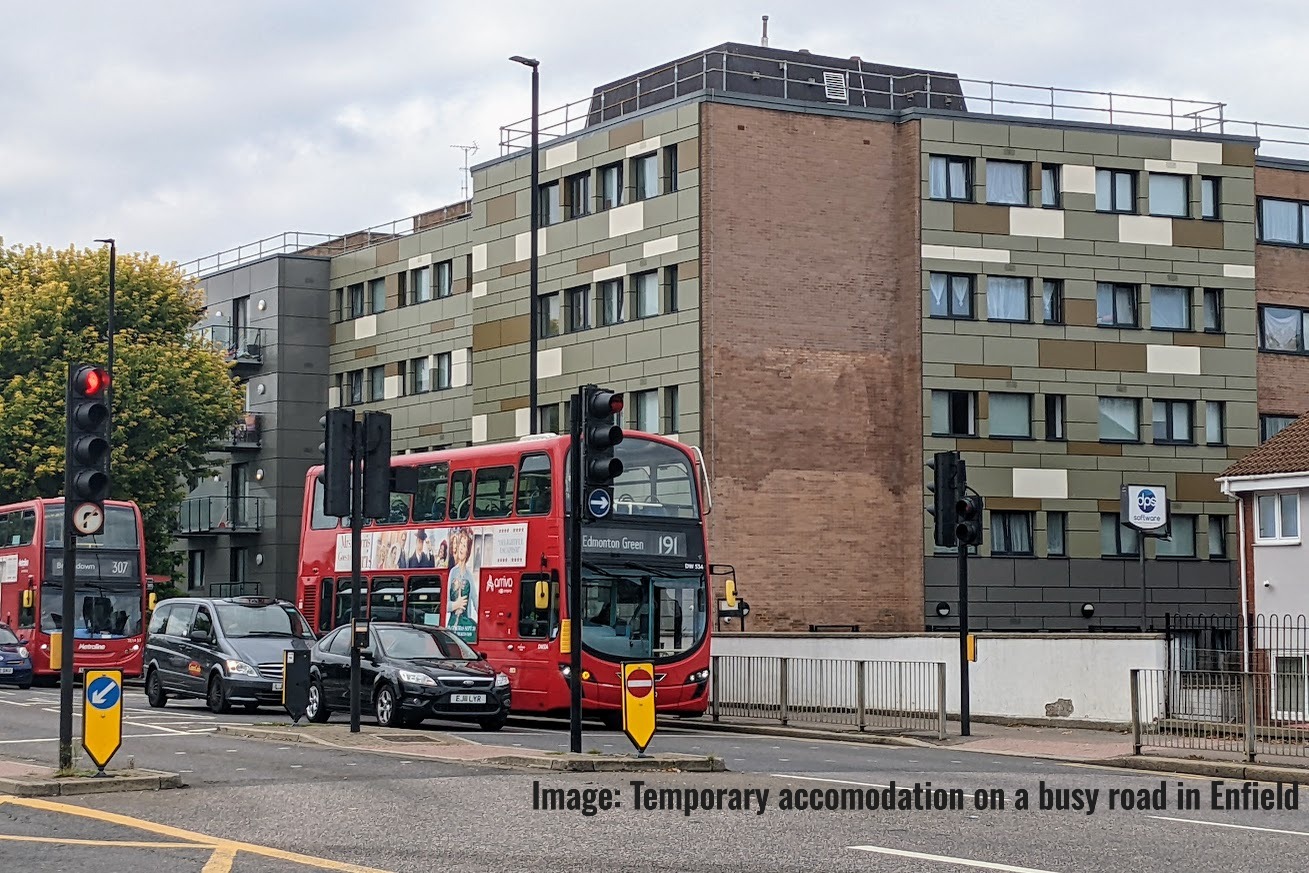
How government underfunding, high rents and policy failure are driving homelessness in Enfield and across London
IN BRIEF
- Enfield’s homelessness crisis is not a mystery. It is the predictable result of high rents, too little social housing, and housing benefit support that falls short.
- More than 3,000 Enfield households, including over 4,500 children, are still living in temporary accommodation.
- Temporary accommodation can harm health, disrupt schooling and employment, and leave families stuck for years.
- Councils are legally required to house homeless families, but central government is not properly funding that duty.
- The bill does not disappear. The costs land on councils, local council taxpayers and local services, squeezing budgets for the things everyone depends on.
- This is a false economy: families lose, children lose, councils lose, and a few landlords win.
- Reducing the number of households in temporary accommodation means changing policy, not just talking about housebuilding. Close the rent gap, properly fund prevention, and build more social rent homes.
Rates of homelessness in Enfield are among the highest in the country. The government’s most recent homelessness data shows there are still over 3,000 Enfield households living in temporary accommodation, including over 4,500 children. [1]
The route into homelessness and temporary accommodation for many families in Enfield is well understood. Evidence shows there are not enough low-cost social rent homes, and private sector rents have risen beyond what many households can afford, even with support towards housing costs. When housing support does not cover rents charged by landlords, it can lead to rent arrears, eviction and homelessness. [2]
Successive governments have failed to properly invest in social rent housing and have allowed existing homes to be sold off or demolished to make way for expensive private developments. [3] At the time these decisions were made, it was assumed that housing benefit would “take the strain”, enabling families to afford private rents where social housing was unavailable. [4]
But in practice this has proved increasingly unfounded. The level of support a low-income family in London can receive towards housing costs is no longer enough to cover their rent. Housing benefit has not been “taking the strain.” The consequences are clear: homelessness and the use of temporary accommodation has surged. Research suggests that one in 21 children in London is now living in temporary accommodation. [5]
There is now overwhelming evidence that temporary accommodation can cause real harm. It damages health, disrupts children’s education, makes it harder for parents to work, and cuts families off from support networks. Repeated moves, overcrowding, poor conditions and long journeys create constant stress and instability. In the most severe cases, the consequences are devastating. [6]

Figure 1 – Enfield Council’s temporary accommodation in Harlow does not provide adequate play space, so children play in the car park.
Many families then remain trapped in temporary accommodation for years for the same reason they became homeless in the first place: they still cannot afford private rents.
Councils have a legal duty to house homeless families, but central government does not adequately fund that duty. As a result, councils must cover the gap between the cost of housing families and the funding they receive from government, at significant cost to taxpayers. Academics from the London School of Economics (LSE) estimate that councils across London face a funding gap of more than £740 million when housing homeless families. In effect, this is about £202 (11%) of the average council tax bill in London. [7]
Ultimately, covering the costs of temporary accommodation means less money for other council services. The LSE report is explicit that this squeeze on finances affects everything else councils do, including libraries, youth services and family support. It warns that temporary accommodation costs are now one of the biggest threats to the financial stability of London boroughs. [8]
The reality is the government’s approach to housing support and homelessness is a false economy. Ministers save money on housing support on paper, only for much larger bills to emerge later in homelessness services and temporary accommodation charges. The costs do not disappear. They are displaced, multiplied, and pushed onto councils, local taxpayers and homeless families.
There are many losers of this approach. Families lose. Children lose. Councils lose. Council taxpayers lose. Other local services lose.
The clearest winners are those able to profit from desperation. Two thirds of temporary accommodation in London is now supplied by private landlords, often on the most expensive nightly-paid basis, and there is no regulatory limit on what they can charge. [9] Boroughs’ report landlords ending longer leases and returning with nightly-paid deals because they are more profitable. [10]
This is why it is frustrating to hear politicians describe temporary accommodation as simply an unfortunate by-product of a housing shortage that can only be solved through housebuilding. London certainly needs more genuinely affordable homes, especially social rent. But this crisis is also being created, sustained, and even incentivised, by policy choices.
If ministers and MPs genuinely want fewer families in temporary accommodation, they should start with the things that would make the biggest difference, fastest.
- Close the gap between rents and the help people can claim. If support towards housing costs does not reflect real local rents, more families will keep being pushed into homelessness. If government believes raising support would drive rents even higher, it must implement rent controls and other ways of restraining the market.
- Fund prevention properly. It is far cheaper to stop a family losing their home than to pay for months or years in temporary accommodation.
- Curb excessive profits. The current system allows some temporary accommodation providers to charge huge amounts while councils and council taxpayers foot the bill.
- Unblock stalled sites. Where developments have stalled because overpriced new-build flats are not selling, government should work with the Mayor of London to convert those homes to affordable housing, including social rent.
- Set meaningful housing targets. Set targets that focus on social rent homes and genuinely affordable housing that actually reduce homelessness – not just headline grabbing overall housing delivery numbers.
Finally, be honest. The high use of temporary accommodation is the predictable result of policies that are not fit for purpose. Failing to provide enough support for people to pay rent is short-sighted: the costs do not disappear; they are multiplied and displaced. A few landlords benefit: everyone else loses. Housebuilding must be part of the long-term solution, but for the foreseeable future it will do little to help most families already in temporary accommodation. Helping them require a different approach.
The evidence is overwhelming. Report after report identifies the same root causes of London’s homelessness crisis: too few social rent homes, private rents that are too high, and housing support that does not match reality. What is missing is not evidence, but political will. Until government confronts that honestly, more families will lose their homes, more children will grow up in temporary accommodation, and more public money will be wasted responding to a crisis that policy is helping to create.
 Better Homes Enfield