Planning applications for houses in multiple occupation (HMOs) in Enfield rose by almost 1,500% between 2023 and October 2026. Our investigation suggests the Council may have played a part in driving this dramatic increase.
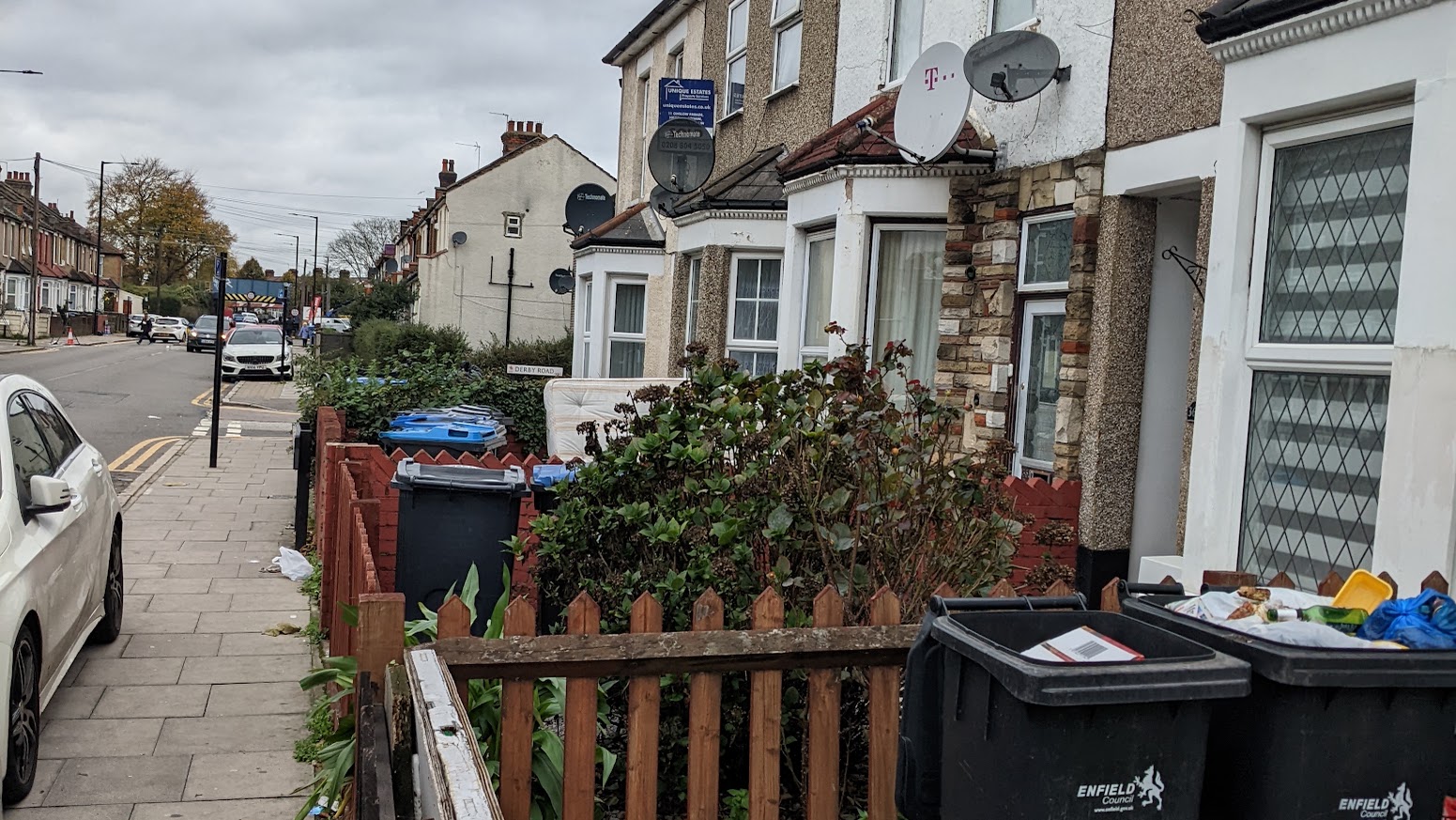
There is increasing concern about the impact of houses in multiple occupation (HMOs), both nationally and in Enfield. Residents have raised concerns about noise, antisocial behaviour, overflowing bins, overcrowding and the loss of family homes.
These concerns are supported by the Council’s own figures. Between October 2018 and September 2023, Enfield Council identified 1,149 HMOs linked to at least one complaint and recorded 4,376 incidents of antisocial behaviour associated with HMOs, including noise, waste, fly-tipping and other nuisance behaviour.
In August, Enfield Dispatch reported that the Council had promised to crack down on HMOs, with a new taskforce and stronger planning controls. The proposals received cross-party support.
But how did Enfield reach the point where a crackdown was needed?
Our investigation suggests that the Council’s own approach to planning and regulating HMOs may have helped create the very problems it is now promising to tackle.
Is Enfield a target for HMO developers?
The figures suggest it is.
Over the ten years from 2013 to 2022, Enfield received an average of just 24 HMO planning applications a year. By 2025, this had risen to more than 300, with almost 600 applications submitted in the first ten months of 2026 alone. That represents an increase of almost 1,500% compared with the whole of 2023.
Enfield also stands out when compared with neighbouring boroughs. Between January 2024 and June 2026, it received almost three times as many HMO planning applications as Barnet and Waltham Forest combined.
Why have HMO applications in Enfield increased so rapidly?
HMO developers are likely to favour areas where their planning applications have a good chance of being approved. And Enfield stands out.
Between January 2024 and June 2026, Enfield Council approved 71% of HMO planning applications it decided, compared with 32% in Barnet and just 15% in Waltham Forest.
These striking differences may help explain why Enfield has become such an attractive location for HMO developers.
Why are HMO applications more likely to succeed in Enfield?
One revealing discovery was an internal Council briefing note from December 2022, prepared for Cllr Susan Erbil, who was then the Cabinet Member responsible for planning and licensing.
The note claimed Enfield needed more HMOs but provided no evidence to support this claim. It proposed advising planning officers to approve HMO applications unless there was evidence of significant harm to the neighbourhood.
But what evidence was there that Enfield needed more HMOs in the first place?
Indeed, the Council’s own published evidence at the time pointed to the need to protect family housing. And the Council has previously cited a shortage of family homes as part of its justification for proposing development on Green Belt land.
We do not know whether the advice in the briefing note was ever issued to planning officers. However, our review of a sample of more than 50 HMO planning decisions found repeated examples of a permissive approach to assessing applications.
For example, we found that:
The loss of family homes was routinely overlooked. When assessing applications to convert family homes into HMOs, planning officers often failed to consider the impact of losing the existing family home.
Policies intended to protect neighbourhoods were weakened. In some cases, planning officers interpreted policies designed to prevent too many homes being converted into HMOs in ways that made those protections effectively meaningless.
The impact on neighbours was downplayed. Planning officers repeatedly claimed that an HMO would have a similar impact to an ordinary family home, without providing evidence to support this. There was little consideration of the potential effects of more intensive occupation or different patterns of activity.
Climate change policies were routinely set aside. Requirements intended to improve energy efficiency and reduce energy costs for future occupants were frequently not applied.
Standards for HMO occupants were applied inconsistently. We found concerning differences in how officers assessed whether proposed HMO accommodation would provide acceptable living conditions.
In short, we found important planning policies were repeatedly applied weakly, inconsistently, or in some cases, not applied at all.
But the problems did not end with decisions to approve HMOs.
Planning permissions usually come with planning conditions designed to ensure developments meet required standards and protect occupants and neighbours.
Yet we repeatedly found that important conditions attached to HMO approvals were poorly worded or, in some cases, missing altogether. We also found little evidence that the Council was checking whether developers were complying with these conditions.
Our investigation also found multiple examples where developers had failed to meet the requirements of their planning permissions, raising serious questions about the Council’s approach to enforcement.
The emerging Local Plan
The problems extend to the Council’s new Local Plan, which sets out how development across the borough will be managed.
Despite committing in 2021 to introducing a specific HMO policy, the Council submitted its new Local Plan for examination in 2024 without one. When Better Homes Enfield challenged the omission, the Council defended its decision.
It was only after a Planning Inspector intervened in 2025 that the Council agreed to introduce an HMO policy. The Council subsequently claimed the original omission was “unintentional”.
Meanwhile, neighbouring Barnet and Waltham Forest were maintaining or strengthening their protections against inappropriate HMO development.
But how could the omission have been unintentional when the Council had been aware of it and defended its decision?
Residents deserve better
The extraordinary growth in HMO planning applications in Enfield, together with approval rates far higher than those in neighbouring boroughs, raises questions about the Council’s approach to HMO development.
The Council’s recent promise to crack down on HMOs is welcome. But it must also examine how its own planning decisions and practices may have contributed to the problems it is now promising to tackle.
There are important questions that need answering.
Why have Enfield’s HMO approval rates been so much higher than those of neighbouring boroughs?
Why have planning policies been applied so weakly and inconsistently?
Were planning officers instructed to take a more favourable approach to HMO applications, and if so, by whom and why?
Why did the Council resist including an updated HMO policy in the new Local Plan?
And why have safeguards intended to protect residents and ensure developers comply with planning conditions been so poorly applied?
We’re calling on the Council’s new leadership to commission a thorough, genuinely independent and publicly reported review of its approach to HMO planning, licensing and enforcement.
Residents deserve more than promises of a crackdown. They deserve answers about how these problems arose and reassurance that the Council will take action to prevent them happening again.
Read our full investigation
Houses in Multiple Occupation: Why has Enfield become a target for HMOs. An investigation of planning decisions, licensing and enforcement.

