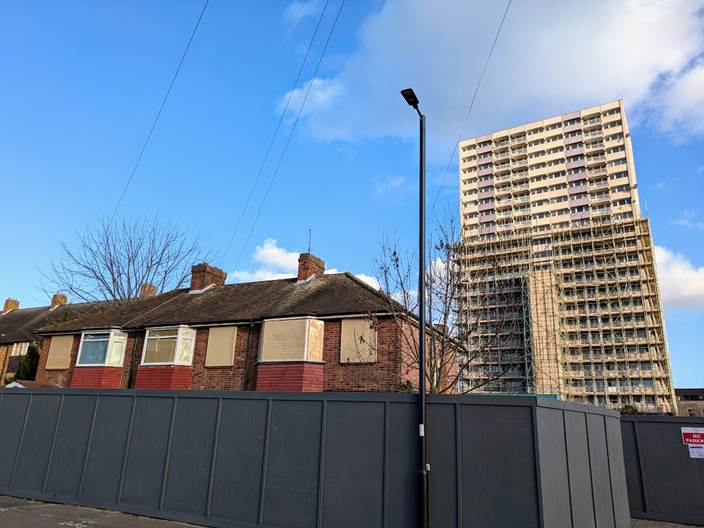
Since 2010, Enfield has gone backwards on Social Rent housing.
Social Rent (including London Affordable Rent) is the only genuinely affordable housing option for many of Enfield’s households, including people stuck in temporary accommodation and families living in overcrowded or insecure private rented homes.
So, when we talk about “housing delivery,” we cannot just talk about overall numbers. The type of homes matters. The housing crisis will not ease if we mainly build homes that local people cannot afford.
Using the GLA Planning London Datahub, the headline is stark: the net change in Social Rent/London Affordable Rent homes in Enfield between 2010/11 and 2025/26 is minus 194.
In other words, despite urgent need, more Social Rent homes have been demolished than built.
How does Enfield compare with neighbouring boroughs?
Enfield’s performance cannot simply be explained away as “the market”. If it were mainly down to market conditions, you would expect broadly similar outcomes across neighbouring boroughs.
But that is not what the data shows.
Table 1 compares the net change in Social Rent homes since 2010/11 across Enfield with neighbouring boroughs. The data shows that while nearby boroughs have made net gains, Enfield has gone backwards.
Table 1: Net change in Social Rent (incl. London Affordable Rent) 2010/11 – 2025/26. Enfield vs. neighbouring boroughs (Source: GLA Planning London Datahub)
| Borough | Net change 2010/11 to 2025/26 |
| Enfield | – 194 |
| Barnet | + 1,087 |
| Haringey | + 1,144 |
| Waltham Forest | + 663 |
As Table 2 shows, across Outer London, only a small number of boroughs show a net loss of Social Rent homes over this period, and Enfield is one of them.
Table 2: Net change in Social Rent (incl. London Affordable Rent) 2010/11 – 2025/26. All Outer London boroughs. (Source: GLA Planning London Datahub)
| Borough | Net change 2010/11 to 2025/26 |
| Greenwich | +2,895 |
| Hounslow | +1,966 |
| Brent | +1,877 |
| Croydon | +1,601 |
| Barking | +1,502 |
| Haringey | +1,144 |
| Barnet | +1,087 |
| Havering | +1,020 |
| Hillingdon | +929 |
| Redbridge | +783 |
| Sutton | +760 |
| Waltham Forest | +663 |
| Bromley | +649 |
| Harrow | +493 |
| Richmond | +411 |
| Kingston | +377 |
| Merton | +226 |
| Enfield | -194 |
| Bexley | -326 |
| Ealing | -3,135 |
Enfield’s latest figures do not include the 138 Social Rent homes nearing completion at Meridian Water. But even after accounting for these, the number of Social Rent homes delivered in Enfield will still be a minus figure of around -56 and still far lower than neighbouring boroughs.
This data does not capture homes lost to disrepair.
The data discussed above does not include the hundreds of Social Rent homes that have been lost in Enfield because they have had to be taken out of use due to safety concerns or the condition of the buildings, for example, Walbrook House, and Shropshire House.
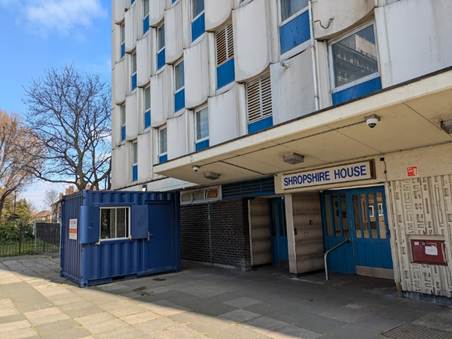
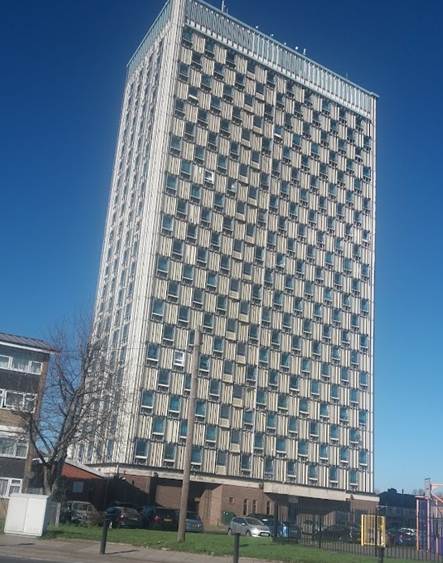
These losses are not captured in the GLA’s planning completions data, but they further reduce the real supply of Social Rent homes available to local people.
Why has this happened?
We should not be fooled into thinking this is just a market failure. Enfield Council’s delivery choices, planning decisions, and the way regeneration has been managed all matter.
Yes, new homes have been built in Enfield – but these were mostly the types of homes which local people struggle to afford, not Social Rent homes.
Regeneration has also reduced the supply of these homes. Estate redevelopment schemes, such as Alma and Ladderswood, were allowed to demolish large numbers of Social Rent homes without like-for-like replacements, to make way for more expensive housing.
Planning policy choices also mattered. Enfield Council – unlike many other London councils – did not bring in an Article 4 Direction to remove permitted development rights for office-to-flat conversions. That meant some sizeable schemes could come forward without providing affordable housing through the normal planning route.
The Council’s new Local Plan, which has not yet been adopted, is changing its policy to lower the proportion of Social Rent homes that new housing developments could be required to deliver, despite the need for these types of homes having increased.
In planning committee meetings, schemes offering to deliver substantial numbers of Social Rent homes have been refused or the decisions deferred – only to then be allowed at a later stage. This has unnecessarily delayed the delivery of new Social Rent homes (e.g. the Moorfield Road development).
In short, the Council has repeatedly decided not to prioritise building new Social Rent homes.
How has this been allowed to happen?
Scrutiny is a key part of democratic governance. It should exist to hold the Council’s decision-makers to account, by testing whether proposals are evidence-based, transparent, and value for money. It also helps improve services and policies by spotting risks early, challenging assumptions, and making recommendations that reflect residents’ concerns and local needs.
However, Enfield Council has significantly reduced opportunities for genuine public scrutiny of its decisions, plans, and performance, including of its record for building additional Social Rent homes.
The few housing-oriented scrutiny meetings that do still take place are often short, and do not go into the level of detail these topics require. These committees rarely produce written reports. We are only aware of a single one being published since 2018, namely the Meridian Water Scrutiny Workstream Report published in 2020.
Conclusion
The bottom line is simple: since 2010, Enfield has gone backwards on Social Rent housing.
This is not an abstract policy problem. It helps explain why many local households are stuck in temporary accommodation, and why families who have lived in Enfield for years cannot find a secure home they can afford.
The Council talks a good game about building Social Rent housing, but away from press releases and announcements, the actual cold, hard delivery data tells a different story. Social Rent housing has simply not been prioritised in the way it needs to be.
This is not a problem that will be solved with another press release. Enfield has a housing crisis, yet over the long run the borough has still managed to go backwards on Social Rent. That isn’t bad luck. It’s the result of what the Council has chosen to prioritise and what it hasn’t.
If Enfield Council is serious, it needs a genuine reset. Social Rent has to become the main measure of success, not an optional extra. Big housing decisions should have to pass a simple test; will this increase the supply of Social Rent homes over the shortest time possible? And scrutiny needs to become real: regular public hearings where officers and partners can be questioned on delivery and performance, not just about future plans.
In short, we need a Council that is organised, able, and willing to fight for the homes Enfield needs.
 Better Homes Enfield