The Government and Enfield Council appear to view businesses at Crews Hill and Chase Park as expendable.
They seem to believe that these businesses, and the hundreds of livelihoods they support, should be removed to make way for a new town.
To be clear, there has, as yet, been no formal decision that the new town will go ahead, and the New Towns Draft Programme consultation has not yet concluded.
Nevertheless, the council’s intentions for Crews Hill and Chase Park, and more importantly the Government’s, are clear. Their repeated announcements and rhetoric are already having a chilling effect on local businesses. Some businesses in and around Crews Hill have said trade is already being damaged. Others have closed.
Unfortunately, this attitude towards businesses and jobs is nothing new in Enfield.
Enfield has a very poor employment record
Over the last decade, Enfield Council has repeatedly failed to protect the borough’s workspaces, businesses, and jobs from redevelopment. It has also blocked new workspaces from being built.
The inevitable outcome is that there are too few job opportunities and Enfield now has very high unemployment rates and weak job growth.
Again and again, existing businesses and the jobs they support seem to be treated as expendable when set against housing targets. That is very short-sighted. Homes matter, of course. But employment matters too. If the aim is to make housing more affordable in Enfield, wiping out livelihoods and local job opportunities is not going to help.
It is not just the direct loss of jobs that matters. When businesses and their employees are removed from an area, the wider benefits they bring are also removed.
Local shops and cafés lose trade.
Business support services such as printers and couriers lose customers.
People lose income, security, skills, purpose, and independence.
Communities lose opportunities and the sense of life and activity that work brings to an area.
A healthy and successful borough needs places for people to live and places for them to work.
Enfield Council has let far too much business space disappear
One reason job growth has been so weak is that Enfield has not kept enough space for businesses to operate.
The council accepts that the borough now needs around 40,000 square metres of additional office floorspace, as well as 304,000 square metres of additional industrial and logistics floorspace.
That is enough space to accommodate thousands of jobs. Yet instead of protecting employment space, the council has allowed substantial amounts to be lost.
Loss of office space has weakened Enfield’s town centres
Office space in Enfield fell by around 52,000 square metres between 2015 and 2025, which is enough to accommodate roughly 5,000 jobs.
This has hit Enfield’s town centres.
In 2018 the council estimated that, on average, each office employee working at a business in Enfield Town spent around £1,500 a year on goods and services in the town centre. Apply that to 5,000 potential office jobs and it suggests a loss of around £75 million in spending power over a 10-year period.
Of course, if an office block is empty, has no realistic prospect of being reoccupied, and can be turned into decent housing, that would be easier to justify.
The problem in Enfield is that viable office space has too often been lost even when it was clearly needed and being used by local businesses.
The quality of the housing created by office conversions is also highly questionable.
The council was warned years ago that the loss of office space could damage town centre growth, yet it failed to take action to control the losses. That decision is also hard to square with the council’s own adopted planning policies, which say town centre office space should be protected.
Industrial space and jobs have been lost
Enfield also needs more industrial and warehousing space, not less. Yet the council’s own evidence shows the borough lost around 65,000 square metres of its industrial stock between 2014 and 2023.
This could have accommodated roughly 700 to 1,800 jobs, depending on whether that space was used for warehousing or manufacturing.
Some parts of the borough have seen gains, while others have seen major losses. The clearest example is Upper Edmonton, where the council’s Meridian Water scheme has resulted in a large loss of industrial floorspace and jobs.
The demolition of more than 70,000 square metres of industrial space at Meridian Water meant the loss of capacity for between 800 and 2,100 jobs.
Much of that loss was avoidable.
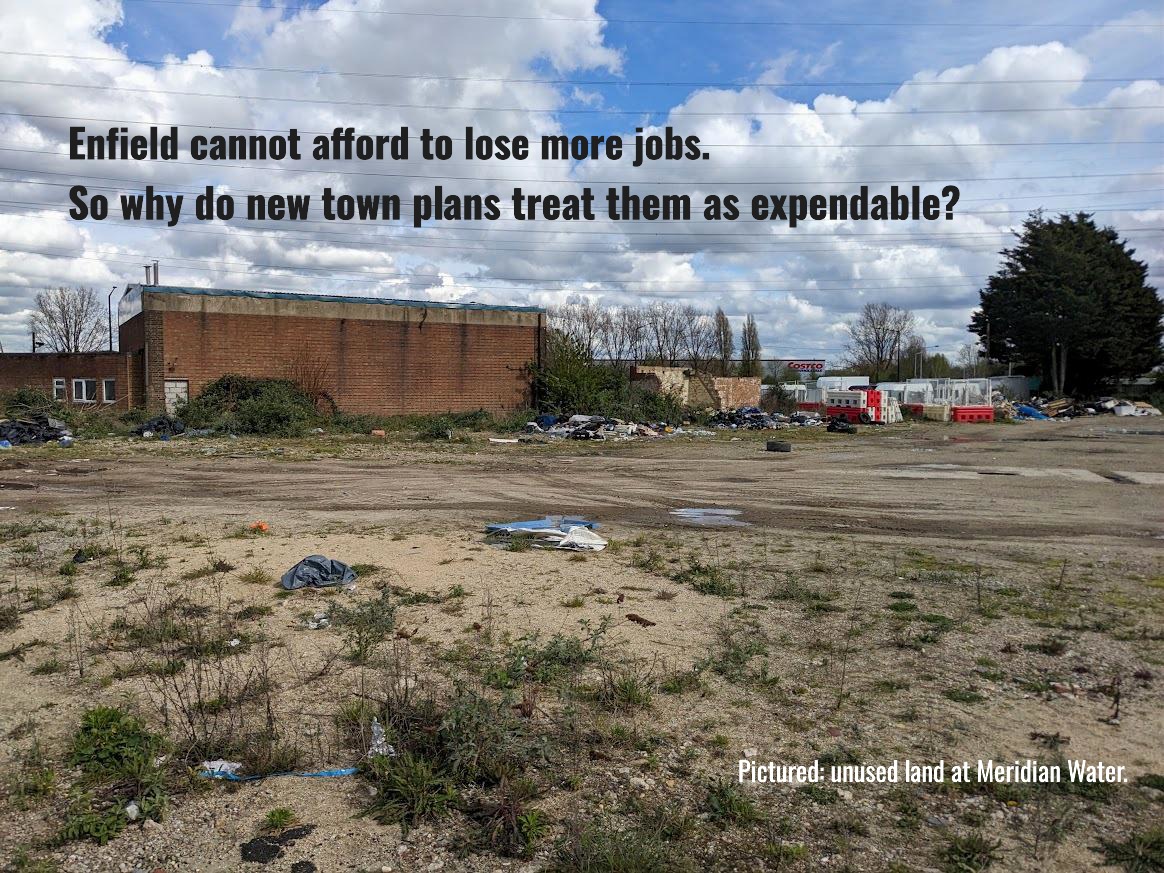
Most of the land was not quickly redeveloped. Instead, it has remained largely unused, or at best underused, for 10 years. Hundreds of jobs were cleared away long before either housing or meaningful replacement workspace was realistically going to be delivered. Large parts of the site were left insecure, barren, and heavily fly-tipped.
Is this what is in store for the businesses at Crews Hill? Viable local enterprises and jobs removed, only for the land to remain empty or underused for years?
We think there is a real risk of this, given the council’s track record.
The council has blocked new workspace
To make matters worse, the council has at times blocked attempts to create new workspace.
At Meridian Water, the council blocked proposals for new workspace that could have supported hundreds of jobs over the past 10 years and boosted Edmonton’s local economy.
And it is not just Meridian Water. In Brimsdown, for example, the council resisted proposals to reconfigure an ageing industrial estate in a way that would have created substantial additional floorspace, while also freeing up brownfield land near a station for a large amount of new housing. Instead, the site remains underused.
Taken together, this is not a one-off mistake. It is a pattern: business space is allowed to disappear, while replacement space is delayed or blocked. The result is weak job growth, fewer local opportunities and a borough now struggling with high unemployment.
And the problem does not end there. There are more potential job losses coming, and not only at Crews Hill and Chase Park.
Edmonton Green Shopping Centre
Edmonton Green Shopping Centre is a telling example.
Plans to redevelop the shopping centre have been supported and approved by the council despite the potential loss of over 800 on-site jobs.
Yet instead of treating that loss as something to be avoided, the legal agreement behind the scheme includes a mechanism under which the developer pays the council £4,500 for each full-time job lost. That money is said to be for relocation, retraining, or replacement employment.
This is a troubling approach. It treats employment loss as something to be managed and paid for, rather than genuinely avoided. It secures a payment to the council, but it does not appear to guarantee that affected businesses will be retained or properly relocated, or that workers themselves will be protected.
Put more bluntly, jobs are lost first, and money is then handed to the council to sort out the consequences. Given Enfield’s record on protecting business space and employment, that is not especially reassuring.
Edmonton Green and proposals for Crews Hill and Chase Park are not isolated examples. The council’s new Local Plan proposes dozens of sites for redevelopment where workspace and therefore jobs could be lost or at least significantly reduced.
The excuses do not stack up
Some argue that housing should take priority and that businesses can simply relocate. Neither claim stands up to scrutiny.
People need homes, but they also need places to work and earn. And relocating a business is easy to say but much harder to do.
Suitable premises may not be available nearby. Moving can be expensive. Staff may face longer commutes and leave. Some firms may downsize, and others may close altogether.
Once an area is earmarked for redevelopment, there can also be a chilling effect, with businesses delaying recruitment, shelving expansion plans, or leaving early because of uncertainty.
For example, any major redevelopment at Crews Hill and Chase Park is years away, if it happens at all. Yet the chilling effect of the council’s and the Government’s rhetoric is already taking hold, with business owners saying the uncertainty is denting trade and leaving them in limbo, while long-established businesses are closing.
Some may argue that regeneration supports jobs in construction, planning, and design. That is true. But those jobs are temporary, and only a limited share usually go to residents. They are not a long-term substitute for permanent local jobs.
Some will also claim that redevelopments re-provide employment space. However, replacement workspace and jobs promised during the planning process often do not materialise. They rarely offset the job losses.
That is why the threat to jobs at Crews Hill and Chase Park should not be brushed aside with vague promises about relocation and replacement. Those are not a substitute for protecting jobs in the first place.
Employment land in London is protected for a reason
Employment land is where livelihoods are based. Offices, workshops, warehouses, shops, and industrial units provide local jobs, support supply chains, and bring spending into nearby town centres.
They also create apprenticeships, entry-level opportunities and the everyday economic activity that keeps a borough functioning.
That is why London and Enfield have planning policies to protect employment land. Once it is lost, it is very hard to replace. Businesses are pushed out, suitable space is hard to find, and local job opportunities shrink.
These protections exist because the pressure to replace employment land with housing is constant. In London, residential development generates higher land values than employment use. Without firm planning controls, there is a strong incentive to replace workplaces with housing.
That may be profitable for landowners and developers, but it is not always good for the local economy or for local communities.
People need affordable homes, but they also need places to work and earn.
That is the real problem with the approach now being taken by the council and the Government at Crews Hill. They treat jobs as easily expendable, at a time when Enfield can least afford to lose them.
Whatever is decided about the future of Crews Hill and Chase Park, the existing businesses must be valued and treated as assets that form part of the area’s future, not something to be brushed aside.
The report with references and notes can be downloaded here.


3 thoughts on “Enfield cannot afford to lose more jobs. So why do new town plans treat them as expendable?”
Comments are closed.