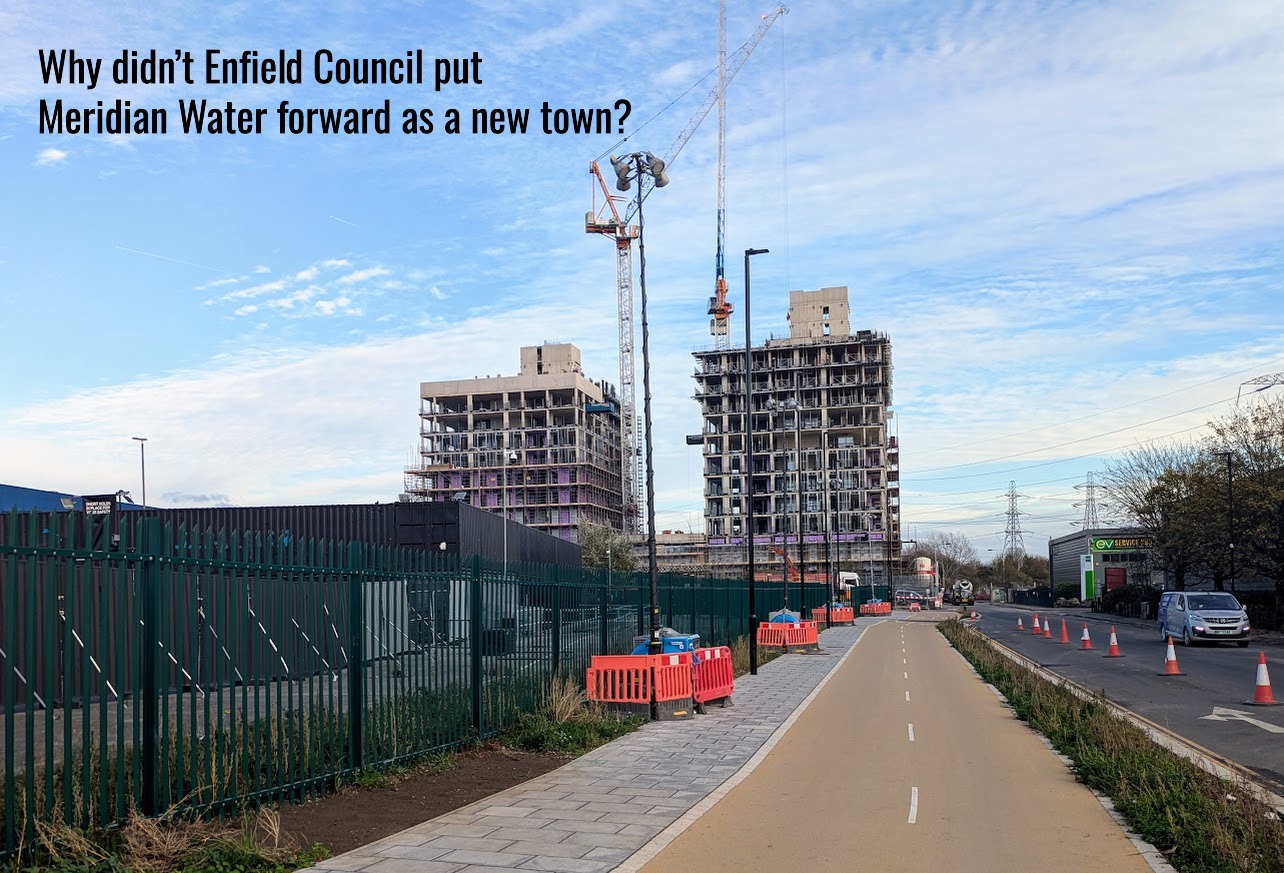
Meridian Water was an obvious candidate for the Government’s new towns programme. It is a very large, self-contained brownfield site that has struggled to deliver. Formal new town status could have made a real difference by helping to get the project back on track. It could have accelerated the delivery of new homes and jobs.
Yet the council did not submit Meridian Water to the New Towns Taskforce. Why not?
Meridian Water appears to have met key criteria for a new town
Enfield Council previously described Meridian Water as “the ambitious programme to create a new town in London of up to 13,000 homes.”
Meridian Water also appears to have met the Government’s broad new town criteria.
First, it is large enough, planned at a scale of at least 10,000 homes, and is a distinct and self-contained site located in an area of high housing demand, backed by a long-standing growth and regeneration strategy.
It also has major public investment, transport improvements, land assembly, and delivery structures in place. As a brownfield site, it would have aligned with both the Government’s and the Mayor of London’s brownfield-first approach to housing delivery.
As it stands, the council’s draft Local Plan only commits Meridian Water to 7,100 homes by 2041 and 8,450 in total. A formal new town designation could have helped speed up delivery and put the scheme on a more credible path towards the 10,000 to 13,000 homes previously promised.
There would have been clear benefits to new town designation
A formal new town designation for Meridian Water could have brought real advantages. It would have raised its national profile, strengthened the case for extra government funding, and given the scheme more political weight and institutional backing. It could also have helped speed up infrastructure delivery and improve coordination between the council, government departments, transport bodies, and other key delivery partners.
Importantly, it would have brought access to more specialist delivery expertise. Meridian Water has relied heavily on the council acting as master developer, but the record has been weak. New town status could have helped bring the skills, oversight, and long-term backing that a scheme of this scale needs to keep it on track.
In short, new town status could have accelerated the delivery of new homes and jobs and may also have helped increase the number of genuinely affordable homes. It could also have improved the council’s chances of recovering its investment in Meridian Water and of reducing the huge debts it has built up.
So why didn’t Enfield Council put Meridian Water forward as a new town?
In our opinion, the most likely answer is that Meridian Water was politically too awkward to put forward.
It is the council’s flagship regeneration scheme, yet it has missed major deadlines, delivered far fewer homes than promised, and drifted through repeated changes without a new masterplan. Submitting it as a new town site would have invited an obvious question: if this is already the council’s flagship project, why does it now need new town status, outside expertise and stronger central backing to succeed?
It would also have opened the door to much closer scrutiny of the project and the council’s record as master developer, including missed targets, changing delivery models and the huge gap between the promises made and what has been delivered.
Submitting Crews Hill and Chase Park as a new town site was politically easier. It allowed the council to sell a story of future ambition rather than expose Meridian Water to detailed scrutiny.
The result is that Enfield passed over the borough’s most obvious brownfield site for new town status and instead promoted a more contentious proposal on largely greenfield land. That decision deserves much more scrutiny than it has received.
If new town status could have helped unlock faster delivery, better oversight, and more homes at Meridian Water, then the real question is not just why the council backed Crews Hill and Chase Park. It is why it chose not to pursue that support for the scheme it was already supposed to be delivering.

